

“Color is descriptive. Black and white is interpretive.” — Elliott Erwitt, American documentary photographer
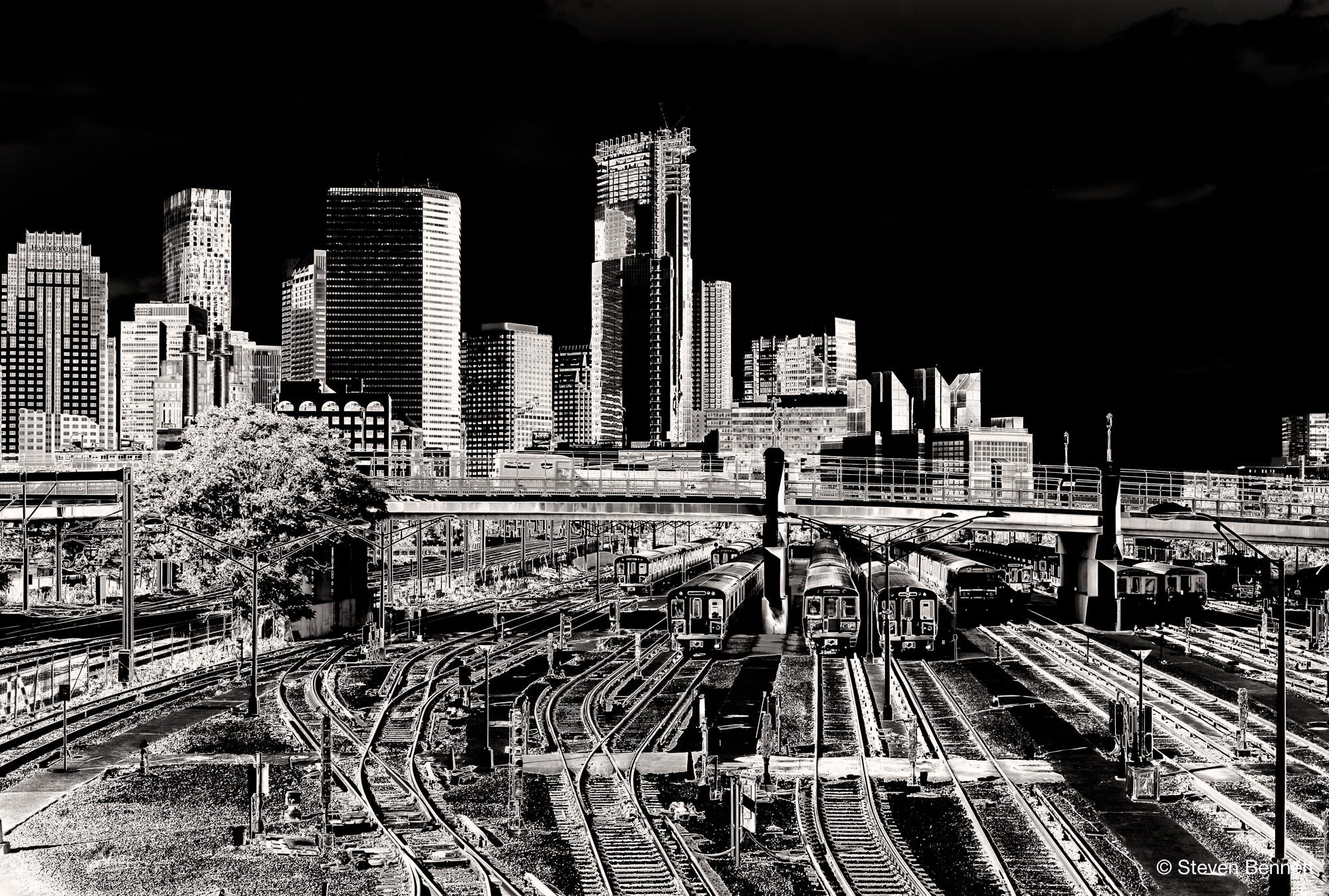
Your Eyes: What Do You See?
Immediate Impressions
What strikes you first about this image?
Longer Look
How do all the lines and shapes affect the way your eye moves through the urban landscape?
Look Again
In what ways does the black-and-white treatment affect how you see this scene?
My Eyes: Behind the Photograph
I never tire of photographing Boston’s MBTA yard from the West 4th Street bridge.(Through the chain-link fence, actually — I own a couple of lenses with front elements small enough to shoot through the wire openings.) I cross that bridge every time I take the subway to my studio in the the city’s South End area.
While I’ve produced this image in color and have experimented with unusual framing and digital effects (see below), the high-contrast black-and-white version is my favorite, with its woodblock-like feel.
The B&W version is printed on sheer aluminum via dye-sublimation, a process that heat-transfers the image directly into a specially coated metal panel instead of laying ink on top of paper. On sheer aluminum, the lighter areas allow more of the reflective aluminum surface to show through, while the darker areas show as solid color. The high-contrast B&W, combined with the aluminum substrate, reduces the scene to its bare elements.
My goal was to create a view of Boston built on compositional tensions: the city’s angular geometry contrasted with the maze of crisscrossing, curving tracks below… the one living thing in the frame (that tree at the edge) standing its ground against all the steel and glass… and finally, the subway cars themselves, their rounded corners contrasting with the buildings on the skyline.
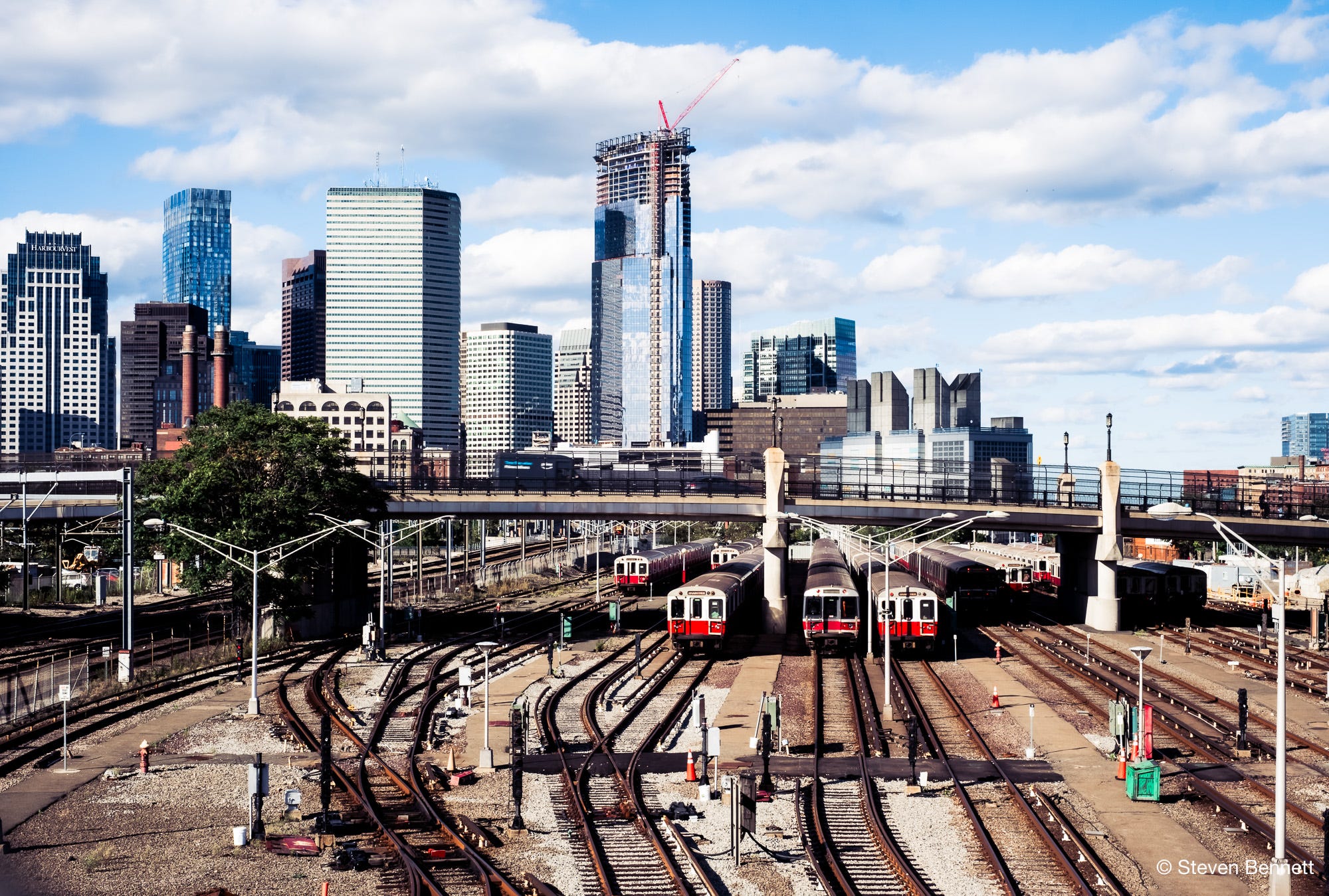
Color or B&W
For comparison, here’s the same view rendered in color. I very much liked the billowy storybook feeling of the clouds and the pops of red on the subway cars.
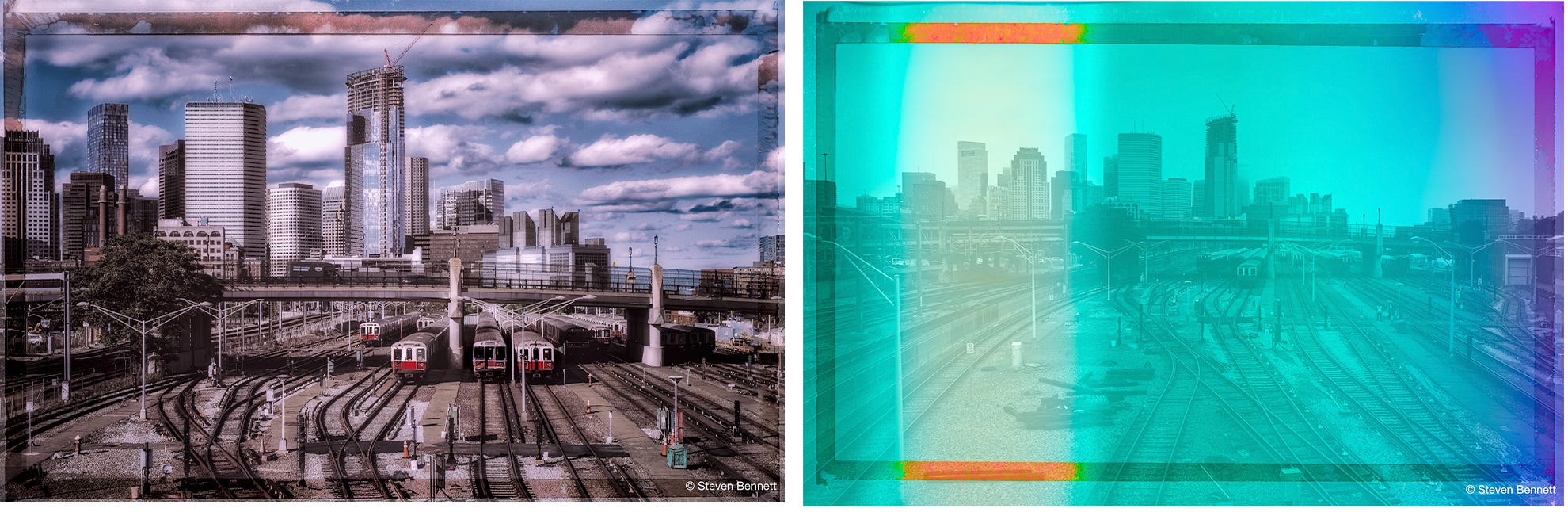
Variations on a Theme: Works in Process
Before landing on the high-contrast B&W version, I experimented with non-traditional ways of digitally framing and manipulating the scene. I’ll continue to iterate and transform. Stay tuned for a future post.
The Soul of the City
“When you photograph people in color, you photograph their clothes. But when you photograph people in black and white, you photograph their souls.” — Ted Grant, Canadian photojournalist
Grant was talking about people. But I think the same applies to a city. Strip away the color, and what’s left is the essence of the metropolis, stark and bold.
That TREE!!!
Natural life overwhelmed so entirely by our urban life in this 21st century. The trains and the tracks transport us even further back in time. But that tree! - that tree stands in any time - all throughout time - and commands attention.
What I see first, perhaps, is what I don’t see. There are no people in this photograph. Yet I imagine them everywhere. I imagine them inside the buildings, behind the windows, in the trains and in the cars. People going to work, coming home, waiting, leaving, arriving. Lives being lived even though we cannot see them. The tracks seem to go everywhere, crossing one another, separating, disappearing into the city. They make me think of all the different directions our lives take. We cross paths with people, sometimes only for a moment, and then continue on our own way. the black and white makes the photograph feel almost like a drawing to me. It takes away the distraction of color and leaves the lines, the shapes, the light and the shadows. My eye keeps moving through it. But I keep coming back to the people who are not there.
And then I realize there is one person I do see. I see the person behind the lens, looking, choosing, recording it all. I imagine him standing there for that moment, seeing something in this place that made him take the photograph. His presence is there too.
In some ways, I also see my paintings, I am interested in what I do not describe. I do not want to tell the viewer everything. I leave things out, leave spaces open, so that imagination can enter. What is absent can sometimes become just as important as what is present.
Maybe that is what interests me most here. I don’t see the people, but I feel them. I feel the lives inside the buildings, the people moving through the trains, and the person behind the camera quietly observing it all. What we don’t see allows us to imagine so much more. I love the quotes too, especially this one, it says it all!
“When you photograph people in color, you photograph their clothes. But when you photograph people in black and white, you photograph their souls.” — Ted Grant, Canadian photojournalist