
Clock Rules
The trains don't negotiate

“Abstract time became the new medium of existence. Organic functions themselves were regulated by it: one ate, not upon feeling hungry, but when prompted by the clock: one slept, not when one was tired, but when the clock sanctioned it.” — Lewis Mumford, Technics and Civilization (1934)
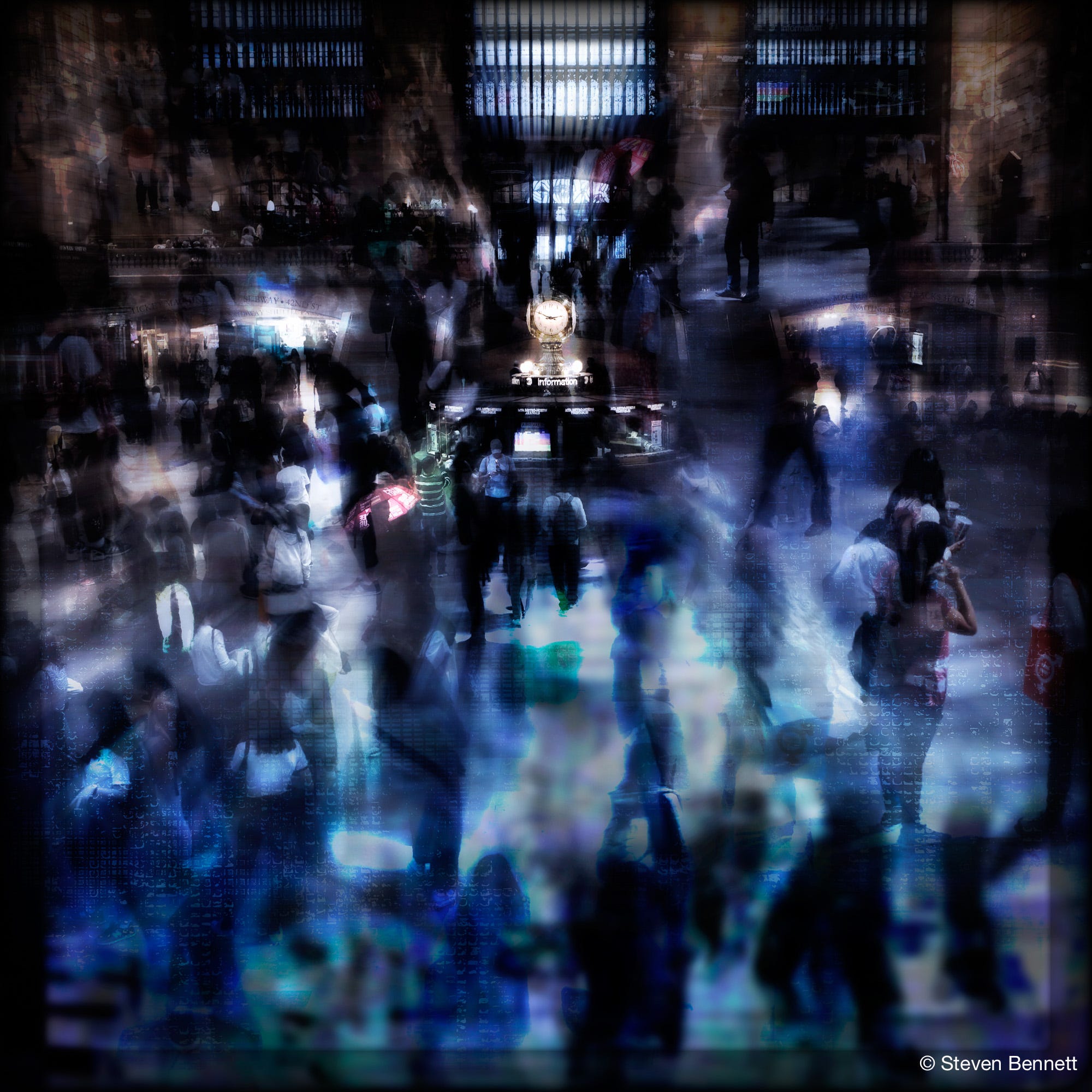
Your Eyes: What Do You See?
First Impressions
Go with your gut reaction…
Where does your eye land first — and what route does it take from there?
Taking the whole scene in at once, what’s the first sensation that comes to mind?
Does the image convey a sense of motion or suspended animation?
Longer Look
Now that you’ve spent a little more time with the image…
Look past the crowd — check the edges of the frame, and the surface of the scene itself. What do you find hiding in plain sight?
Has your first-blush feeling shifted, now that you’ve looked longer?
Put yourself in the scene: pick one figure out of the blur. If that were you, what might you be feeling or thinking?
My Eyes: Behind the Artwork
You’re looking at a composite artwork featuring the main concourse of Grand Central Terminal in New York City. I stood on the East Balcony overlooking the floor, taking dozens of photos as throngs of people ebbed and flowed through the morning commute.
The Components
I propped my camera on the balcony’s railing. Some shots were taken at very slow shutter speeds; others just fast enough to freeze motion and keep the human forms discernible. I also took a number of environmental shots of the concourse itself at speeds high enough to keep the architectural and iconic elements (the clock and info booth) crisp. I wasn’t sure what I’d do with any of it, so back home it all went into my component bank, which consists of thousands of images, tagged for search, waiting for the muses to suggest a composition. That might be the next day or a month, or sometimes even years later.
Inspiration
Almost a year to the day, the muses sang after I read an art call, “Off the Clock.” The juried exhibition sponsored by Fort Point Arts Community — of which I’m a member — invited works that “…investigate the meaning of timelessness and its consequences. What does it mean to exist outside of time? Or are humanity and time interlaced?” Accepted entries would hang at the Gallery at Atlantic Wharf in Boston’s Seaport, July 8 through September 27, 2019.
Reading the call, I immediately thought of that morning at Grand Central — the scores of photos of people swarming toward commuter rails and exits and their places of work — and of shots I’d taken later that same day of people rushing, as they always seem to do in New York. After hours of layering and manipulating images, I had two candidates for submission: Clock Rules and 2:55.
The Making of the Image: Clock Rules
For Clock Rules, the featured image in this post, I layered dozens of the Grand Central photos to create a chaotic stream of people, then added a radial blur streaming toward the clock (that connotes the “whoosh” sensation) and blue gradients to create a surreal mood. A semi-translucent digital frame contains all that fluid motion.
For a final touch, I overlaid a faint grid from another piece of my art, Metrovolution: Winter, a city I digitally sculpted from a photograph of ice on a window screen. (See below.) The loose grid added one more layer of abstraction, with a subtle Matrix vibe and attendant symbolism.
The piece went to the jury as Now Boarding (I occasionally retitle a work when a better name surfaces). Here’s the statement:
“Now Boarding focuses on the fact that a shared sense of time is inextricably woven into the fabric of our daily lives. What better place to illustrate our dependency on time conventions than a train station? The train waits for no one. My artwork consists of multiple layers of images taken in Grand Central Terminal, manipulated with digital tools to create a sense of motion. The analog clock atop the central information booth functions as a ‘light magnet,’ drawing the accelerated ghostly human forms into the center. The clock rules.”
Those last three words eventually took over as the title.
The Making of the Image: 2:55
The second piece I made for the call, 2:55, was also accepted. It looks at the human elements of time from street level — midtown Manhattan, shot from inside a Sixth Avenue covered bus stop through glass printed with decorative frosted circles. I debated removing the circles, then decided they were part of the experience of watching the crowds go by. Here too I added a radial blur and zoom to push the sense of rush, layered in several office buildings for an abstract feel, and overlaid a digital timestamp of the moment I pressed the shutter. (The numerals are a close-up of an LED display at a local gas station.)
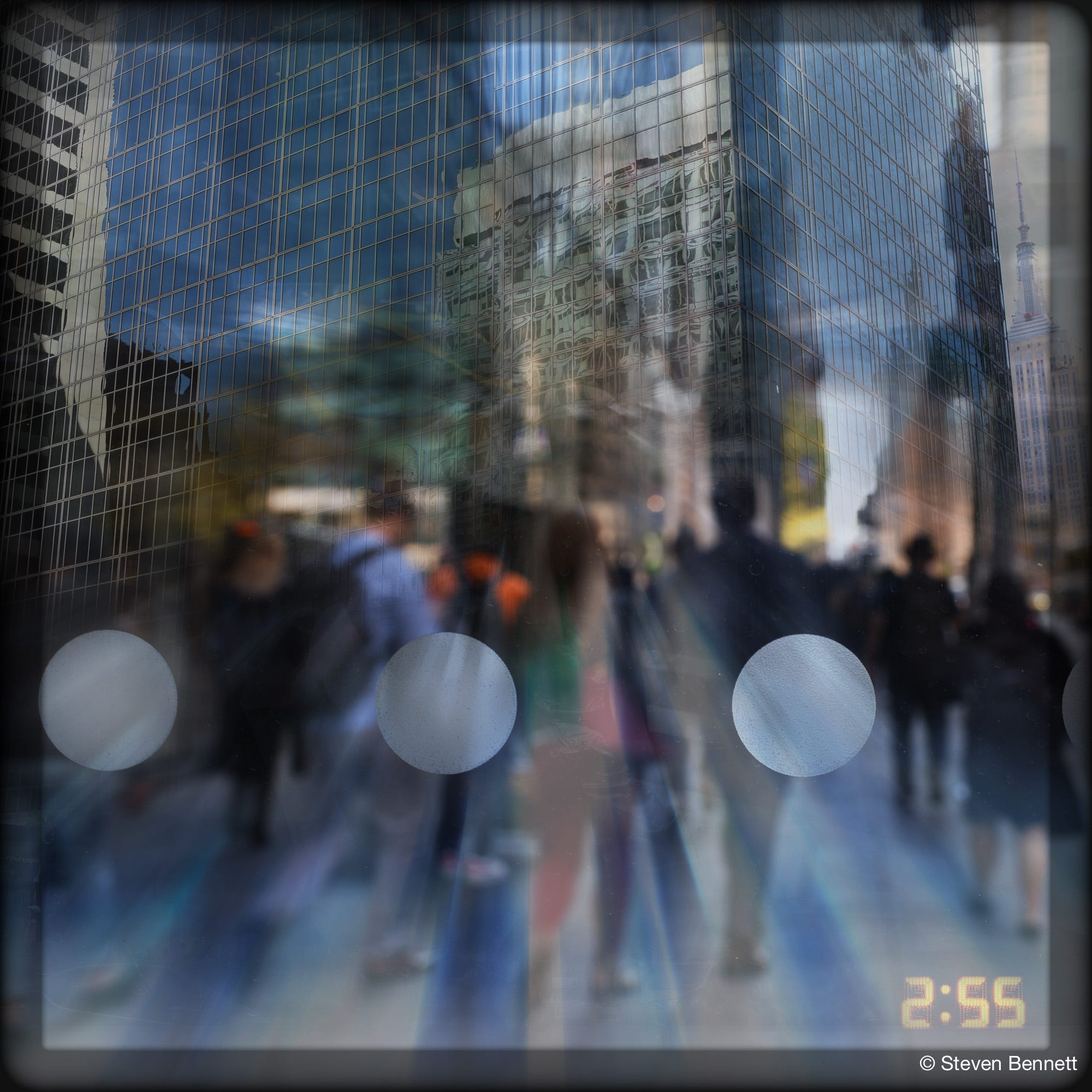
It went to the jury as Time is Money, but I’ve since renamed it for the minute burned into its corner. Where Clock Rules watches the kinetic flow of people from above, 2:55 is inside the flow, cocooned in a glass bubble at sidewalk level, capturing everyone mid-stride. The statement for the artwork ends with: “While we participate in the mainstream of economic activity, we are never off the clock.” The show, remember, was called “Off the Clock.”
And Then Time Skipped a Beat
The show came down at the end of September. That December, the first cases of a novel coronavirus appeared, and soon it was turning the world — and our experience of time — upside down. For those in lockdown, time hung heavy. For those on the front lines, I imagine it flew scarily fast.
During those surreal days of the pandemic, I spent a lot of time processing photos from my work-in-progress folders, and my thoughts often drifted to the hundreds of photos I took at Grand Central. Images of the once-bustling hub in the news and on social media showed a scene devoid of humans, something out of the “Twilight Zone.”
The clock ticked on, but no longer ruled. We were off the clock.
"Clocks slay time… time is dead as long as it is being clicked off by little wheels; only when the clock stops does time come to life.” — William Faulkner, The Sound and the Fury
Learn about the grid underlying Clock Rules

I see Clock Rules as an unambiguous confirmation of the spiritual and metaphorical unity of time and light. Light as enlightenment. Time as a cycle of change. Not separate entities but interwoven. The very tapestry of life. The clockface in focus, centralized, and stationary. Humanity a blur, dispersed, and kinetic. I thought of Henry Van Dyke's poem, "For Katrina’s Sun Dial"
Time is too slow for those who wait,
Too swift for those who fear,
Too long for those who grieve,
Too short for those who rejoice,
But for those who love, time is
Eternity.
This is an amazing image. I had to stop the clock for a moment and just stare at it.