
Gateway to the Void
Where a web of water opens onto nothing

“To see a world in a grain of sand… / Hold infinity in the palm of your hand.”
— William Blake, Auguries of Innocence
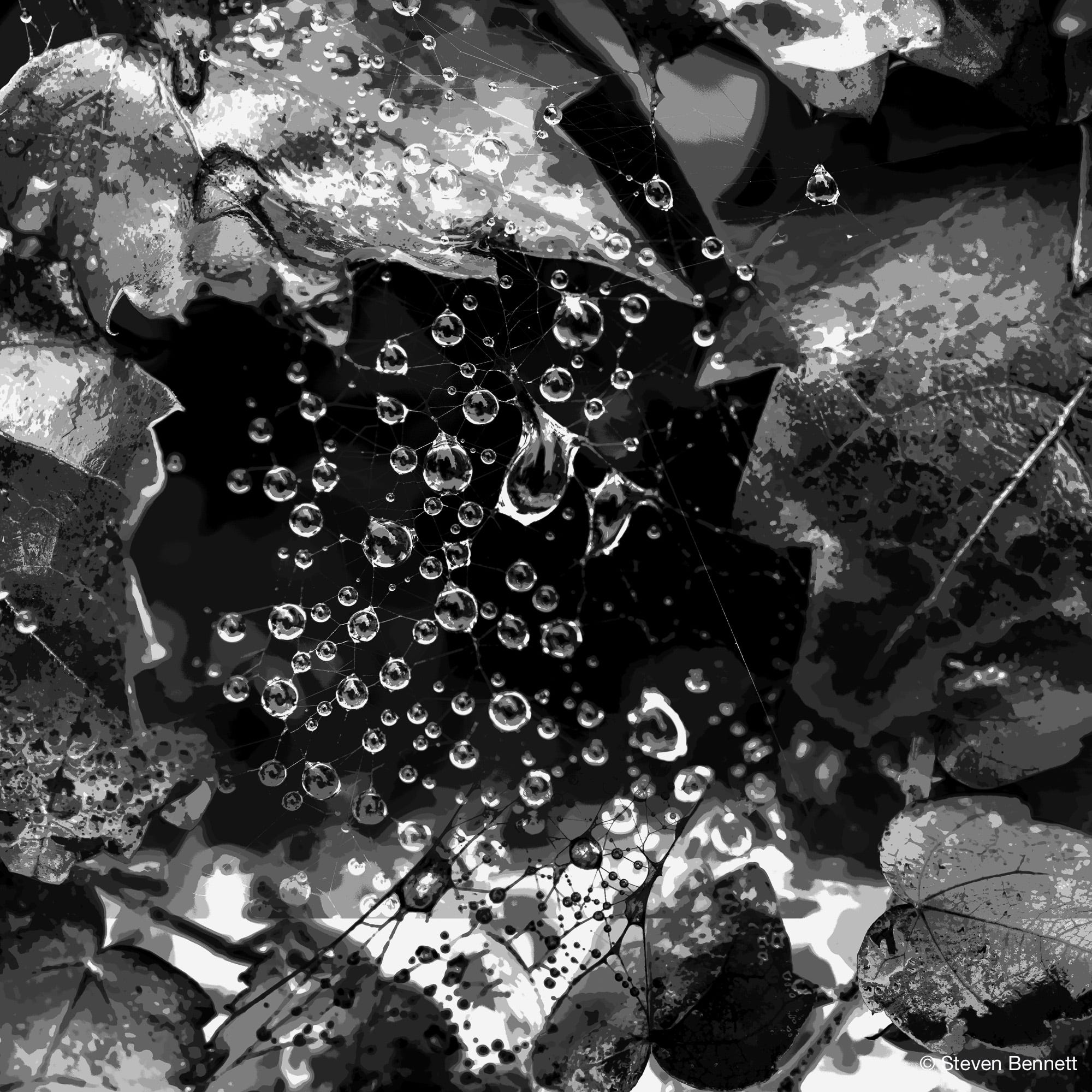
Your Eyes: What Do You See?
First Impressions
Take a quick look.
Where does your eye go first?
What do you think you’re looking at?
Does the image feel intimate, vast, or both at the same time?
Look Longer
Now try some slow looking and see what you notice.
As you spend more time with the image, does your sense of scale change?
Do the droplets feel random, or do you begin to sense an underlying structure?
What role does the dark central space play in the composition?
What details emerge that you didn’t notice at first glance?
My Eyes: Behind the Image
You’re looking at a composite created from two photographs of raindrops suspended in a spider’s web after a light rain. The web itself was strung between two fence pickets roughly four inches apart, although the cropped image makes the scale hard to judge. Read on if you want to learn more about the making of the image.
The Setup
Essential gear: sturdy tripod and 105mm macro lens.
When photographing raindrops, I normally use focus stacking, taking a sequence of images focused at different depths and merging them so multiple planes of droplets remain sharp. That wasn’t possible here. The wind kept the web in motion, and focus stacking only works when the subject remains perfectly still between frames. Instead, I fired a series of burst shots, hoping to catch a brief lull in both the wind and the vibrations from passing trucks. I got lucky. One frame captured the web in near-perfect stillness. I then shot several other sections of the web. Once again, the environment cooperated long enough to capture usable shots that could be combined with the first.
The Transformation
Back at the computer, I blended two of the images and then used a number of Photoshop tools (masks, brightness and contrast adjustments, curves, and gradients) to reduce the scene to simpler, more graphic forms. I selectively posterized the surrounding leaves and deepened the blacks to heighten the visual tension between the luminous droplets and the dark central space.
My goal wasn’t simply to document a spider web. I wanted to reduce the scene to simpler forms and push it toward the boundary between representation and abstraction, creating a moment of uncertainty about both subject and scale. That moment invites viewers to look more closely, linger in the mystery, and experience the familiar in a new way.
The surrounding leaves became a natural frame around the suspended constellation of droplets, while the strong contrast helped transform an ordinary scene into something more mysterious and open to interpretation.
The Print
For some of my work I’ll intentionally print it small for a more intimate viewing experience. For Gateway to the Void, I went the opposite direction: large. I wanted to create an immersive visual presentation that draws the viewer into the depths of the scene.
A large print also accentuates the sense of scale: a 4-inch scene presented at 40 or 48 inches keeps the viewer guessing. The web itself, which in life would fit inside your two cupped hands, becomes a structure you have to step back from to take in its entirety.
On Paper
On paper, I use archival UltraChrome on Pearl photo paper with a satin laminate — a metallic-finish stock that enhances the luminous appearance of the drops.
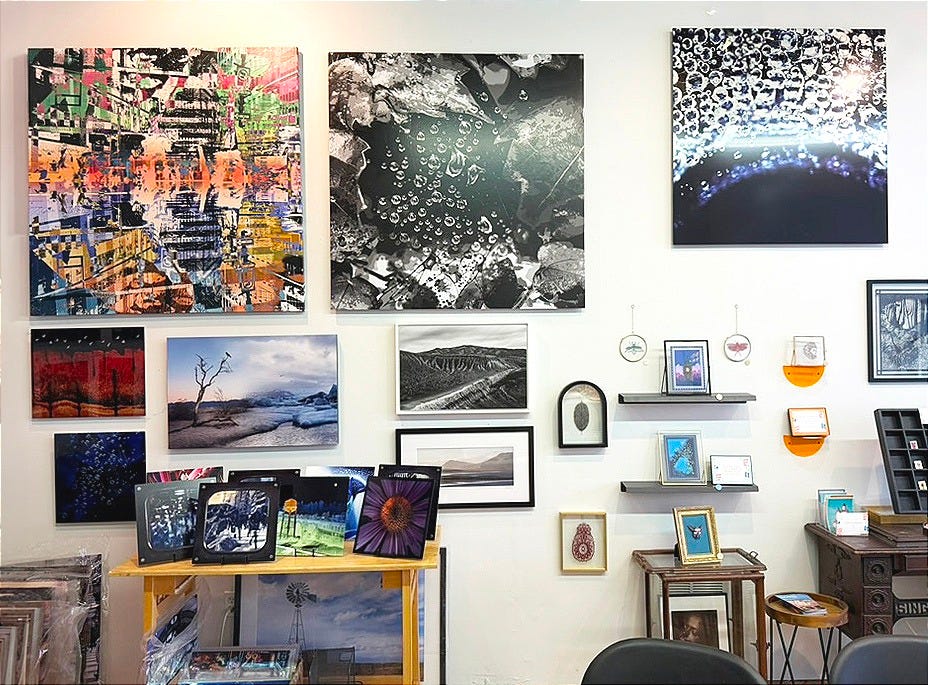
The 48” x 48” photo paper version is on the corporate art rental circuit and has been displayed at Google’s Cambridge offices and in the lobbies and hallways of a number of software, biotech, and pharmaceutical companies.
On Metal
When printed on aluminum through dye-sublimation, the artwork takes on a different feel. For Gateway to the Void, I chose sheer aluminum, meaning that in the lightest portions of the image, the bare brushed metal shows through rather than being covered by ink. The brightest areas become reflective and ever-changing, shifting with the viewer’s position and the surrounding light. In effect, the piece is no longer black and white. It’s black and… nothing, except for the metal itself.
The Space Between
A spider web is not normally considered a gateway to anything—until you use art to transform the familiar into the mysterious. What begins as a few inches of silk and water becomes a passage into an imagined space, one that exists somewhere between “what is” and “what if.” The spider web remains a spider web. The rest happens in the space between observation and imagination.
“Nature uses only the longest threads to weave her patterns, so that each small piece of her fabric reveals the organization of the entire tapestry.”
— Richard Feynman
wow...very very interesting, rushing out but will look longer later!!!
This image is evolving for me every second. Isn't it wonderful for something evidently flat on the page to not only have so much dimensional character but movement. My eyes went first for a second only at the darkness, but for me it is not a void and certainly may illustrate the momentous character of your quote about a grain of sand. The bubbling rises; it does not descend into a depth. The broken ice I see or imagine surrounding the central chaos reminds me of my lake view in the winter. I live in blizzard country and see the lake changing day by day, if not minute by minute. You certainly see that movement here; nothing is static. The metaphor of a web is good if it is understood as ever-changing, because webs are often symmetric, and, of course, this is not because it is moving; the shapes glide into each other. Then I read your description of the work that went into this, and I find you were working with a spider web that you miraculously ballooned. I'm sure you know about magical realism in literature. Well, this is magical realism in art.
Great work, Steve.
Laurie Hollman