
Nature's Layer Cake
Savoring pastry-puff clouds

“We have always a resource in the skies. They are constantly turning a new page to view.” — Henry David Thoreau
Your Eyes: What Do You See?
First Impressions
Take a quick look.
With everything going on in this scene, where does your eye go first? And after that?
How would describe the mood of the photograph? How does it make you feel?
What's your sense of scale here? What are your reference points?
Look Longer
Now try some slow looking and see what you notice.
What tensions play out in the image?
As you spend more time with the photograph, does your sense of scale change? How about your sense of depth?
How would you describe the interplay of the clouds?
Now that you’ve explored the image, has your emotional response changed? If so, in what ways?
My Eyes: Behind the Image
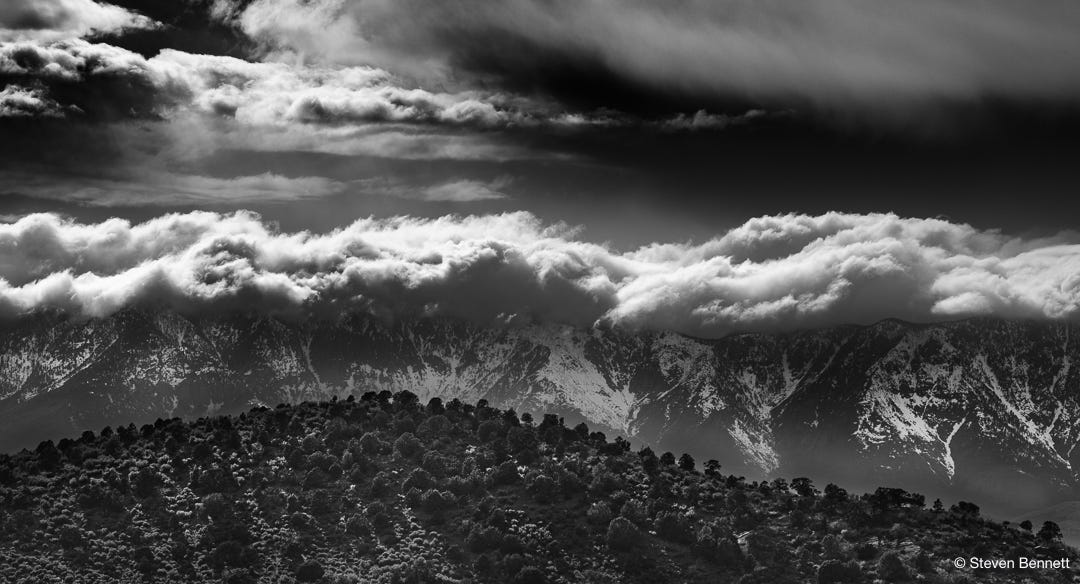
Nature's Layer Cake was taken near the Wildcat Canyon Trailhead off Kolob Terrace Road, in the Kolob section of Zion National Park. The trailhead sits at an elevation of 7,000 feet, which affords an expansive view of the land below.
The day I took the photograph had been a wild rollercoaster, weather-wise. Solid rain in the morning—parts of Kolob Canyon would have been a natural venue for a mud wrestling competition—gave way to mist, which in turn morphed into another downpour, followed by a stretch of cloudy, and then bright, sunny skies.
After a short hike, I headed back to my car and packed up my gear. Sure enough, as an unwritten first law of photography states: the moment you put away your gear, you’ll wish you hadn’t.
The cumulonimbus clouds had reorganized into spectacular organic bands over the ridge below, and I was immediately attracted to the exquisite natural composition: a low tree line anchoring the bottom of the frame, snow on the rock face beyond the ridge catching the light in the middle distance, a separator layer of bright white clouds above, and finally the darker, more chaotic mass of billowing clouds at the top. Earth, mountain, cloud, and sky comprised a natural layer cake, hence the title of the image.
Sometimes a scene calls out to be rendered in color, other times in black and white. This one was clearly the latter. Color would have pulled the eye toward the foliage or the patches of blue sky and lost the progressive visual build from foreground to background. In black and white, the delineation of the bands becomes clear, as does the dynamic tension between the age-old rock face and the evanescent clouds above.
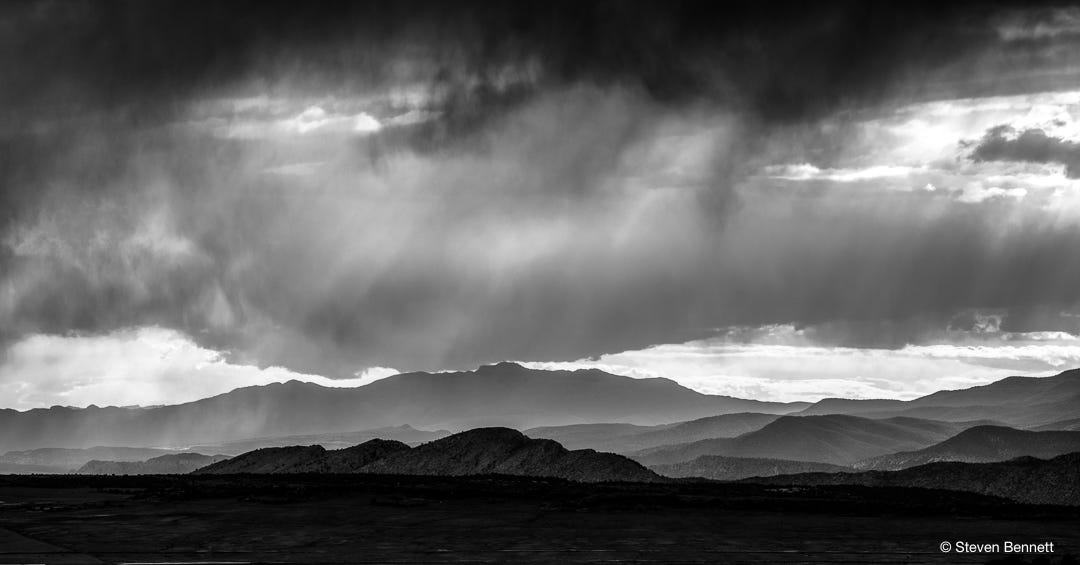
The drive along Kolob Terrace Road back to Springdale, where I was staying, turned out to be its own kind of second dessert. The scene was less dramatic, but the sky wasn’t done layering, calling for another pull-over-and-pull-out-the-gear moment. This time I had my camera and tripod at the ready: I wasn’t going to miss a ray of light piercing the clouds and punctuating the unfolding skyscape.
"Nature is ever at work building and pulling down, creating and destroying, keeping everything whirling and flowing, allowing no rest but in rhythmical motion, chasing everything in endless song out of one beautiful form into another."
— John Muir, Our National Parks,
Sounds corny, but I FEEL UPLIFTED!! Even the slightly leaning down skies above tell me they are about to rise. The depth of black and white colors that don't really exist in pure form because they are composites of colors, voice an ensemble of love and light.
lauriehollmanphd.com