
Next in Line
Listening to the trash

“There is no such thing as ‘away.’ When we throw anything away, it must go somewhere.” — Annie Leonard, environmentalist and author of the book/documentary, The Story of Stuff
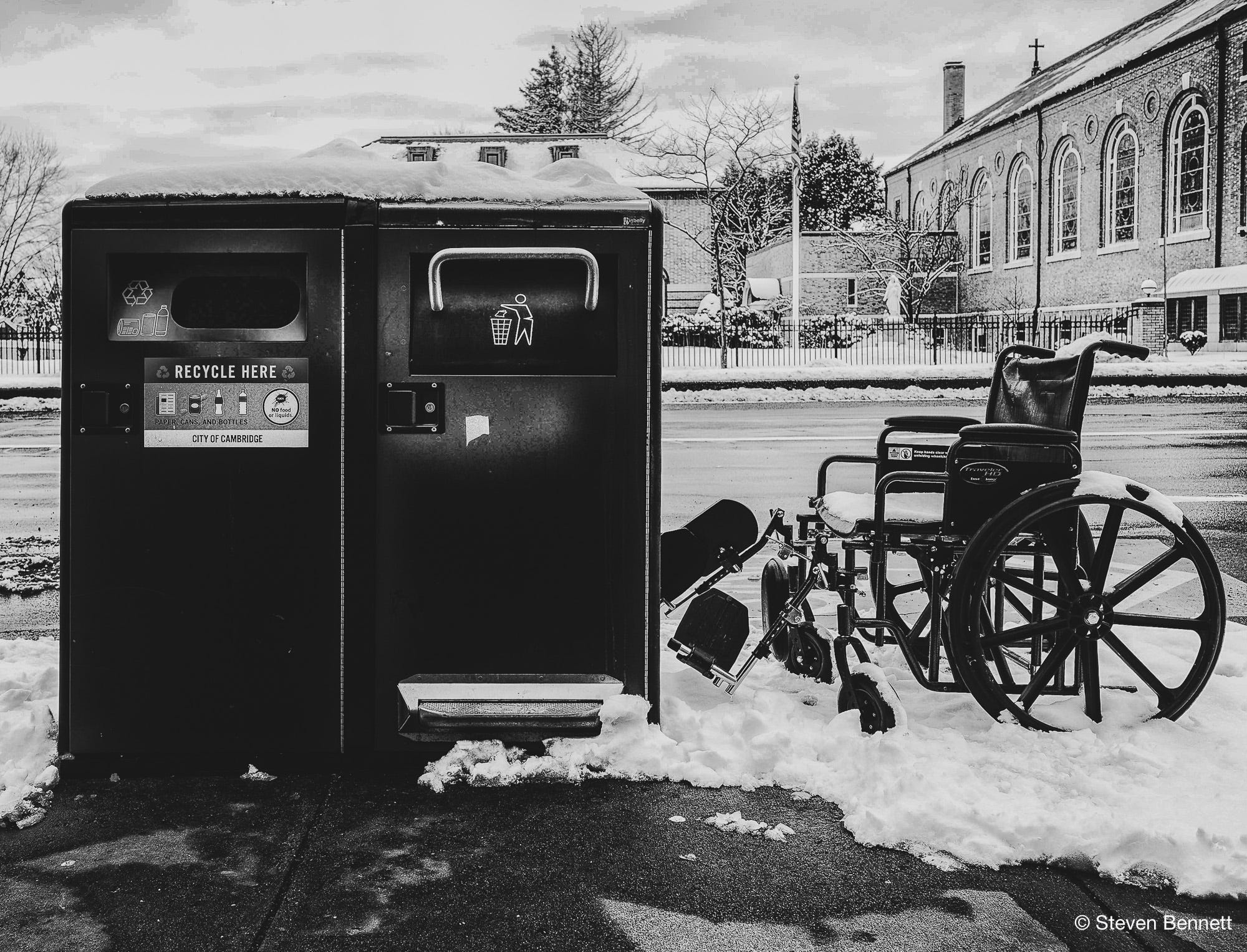
Your Eyes: What Do You See?
First Impressions
Take a quick look before reading on.
What word(s) describe your gut reaction?
What story do you imagine behind this scene?
What questions does it raise for you?
Look Longer
Try some slow looking and see what you notice.
The leg rests are still attached, and snow has settled on the seat. What do those details suggest about how long the wheelchair has been there, and how it was left?
The chair is parked as neatly in line with the bins. Does its placement suggest an accident or a purposeful act of disposal?
Now take in the background. Are there any elements that factor into your reaction or bring additional symbolism to mind?
My Eyes: Behind the Image
Life in the Trash Lane
The curbs of Cambridge, Massachusetts host all kinds of strange inventory. Within a two-block radius of these bins, walking with camera in hand, I’ve come across, among many other items:
an X-ray machine (presumably defunct), articulated arm and all, lying on the sidewalk in front of a dentist’s office
multiple pairs of perfectly good crutches
a therapeutic boot — the expensive kind
all manner of household and personal care items
and, a few blocks farther on, a baby grand piano that had been left outside on an exposed porch all winter, now dismantled and propped up by a dumpster.
Some of the items were bound for the landfill, some for the recycling stream, some still quite usable, some rendered unusable through neglect.
All of them had a story. But the wheelchair-and-trash-bin juxtaposition gave me the longest pause. It wasn’t as absurd as the jettisoned X-ray machine or as sad as the piano (which earned a detailed study and a tribute of its own, coming in a future piece). But it packed the strongest message. Here was a working chair, leg rests attached, wheels sound, standing in perfect alignment with the trash and the recycling bins, waiting to be whisked away with the rest of the detritus. A wheelchair has one job: ferrying passengers who can’t get around on their own. Queue one up for disposal, and the trash begins to speak.
It Is What You See
As with all my found street compositions, I only photograph what’s there. This is my version of the Star Trek Prime Directive — just observe, don’t alter the scene. And while framing a scene is an editorial decision (context matters), here the framing decision was easy: just make sure all three elements were present in the image, with a bit of surrounding context. The scene would have looked the same if I’d staged it as social commentary.
There may well be a mundane explanation for these odd bedfellows. But the question I kept pondering: what’s the chair’s passenger doing now?
"What people have owned — and thrown away — can speak more eloquently, informatively, and truthfully about the lives they lead than they themselves ever may." —William Rathje, Rubbish! The Archaeology of Garbage (with Cullen Murphy), 1992
I ask the same question when I post my images on "Nextdoor." It is amazing what the responses are. Keep shooting!
also made me think: are we throwing away disabled people!